
How about making a small investment in your plumbing system to prevent huge repairs before anything bad happens?
Homeowners whose property is built before 1980 must have some serious plumbing troubles that pose severe risks to their health, decrease the home value, and may cause expensive damage. Pipes become rusty, lead pipes contaminate the water, and old water heaters consume electricity and provide no hot water anymore.
But there is a way to make an easy upgrade and fix all the existing plumbing problems with minimal effort and costs. This post will introduce you to the best plumbing upgrades in 2026 and help you choose what would work better for your property in the United States.
In this blog, we’ll walk through the top plumbing upgrades for older homes in 2026, focusing on what matters most: safety, efficiency, and long-term value for homeowners.
Ditch the Rusty Pipes: Switch to PEX or Copper
The pipes that were commonly used before the 1960s are steel pipes. As a result of exposure to corrosion, rust develops in these pipes, reducing their efficiency to transport water, and leading to leaks. Brown water, weak pressure, and unexpected leaks can be signs that you need to consider replacement.
Cross-linked polyethylene or PEX is usually the material used when replacing old pipelines. It costs from $0.40-$2.00 per foot, which is about 25% cheaper compared to copper pipes at $3.00-$8.00 per foot. Copper pipes are sturdier and less prone to bacterial growth, but are costlier to install at $5.00-$10.00 per foot.
Regardless of which pipe material you select, the installation process will take between $5,000-$15,000 based on house sizes.
Go Tankless: The Smart Water Heater Upgrade
Old tank-type water heaters waste energy by heating water continuously throughout the day, even when there is no need for it. They have an average lifespan of 8 to 12 years before breaking down and occupy space as large as their size.
On the other hand, tankless water heaters heat water only when needed, providing continuous hot water supply while reducing energy consumption by almost 40%. Tankless heaters have a 0.95 or more efficient operation as opposed to 0.58 to 0.60 for traditional heaters, resulting in savings of $150 to $300 on energy bills per year. These heaters last up to 15 to 20 years and are compact as they hang from walls.
Since the government is likely to ban old-fashioned tank heaters by 2029, getting a new heater will ensure future safety and increase property value.
Cut Water Waste with Low-Flow Fixtures
Older faucets, showerheads, and toilets can be quite wasteful when they’re allowed to gulp unnecessary gallons of water. While a typical showerhead uses 2.5 gallons per minute, low-flow showerheads will consume only 1.5-2 gallons per minute while still delivering satisfactory pressure.
Installing low-flow toilets, showerheads, and aerating faucets could help decrease water consumption by about 40%. Dual-flush toilets will use much less water per flush compared to old-fashioned single-flush toilets. Such installation won’t cost you more than $200 per fixture, but will pay itself off soon in lower utilities.
Not only that, but these improvements won’t require professional installation either.
Filter Your Water: Whole-House Filtration Systems
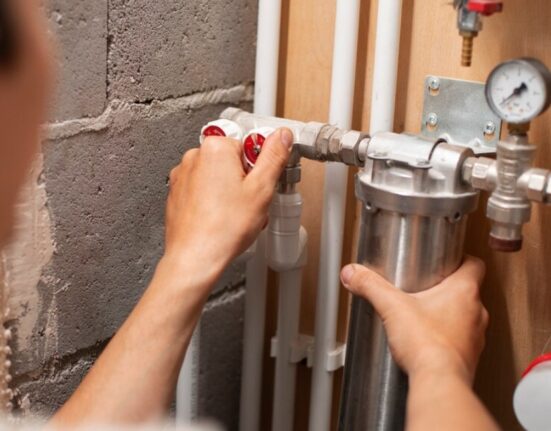
Older plumbing lines can release impurities into the water in your home. Such impurities include lead, sediment, chlorine, and rust particles, particularly if you still use old lead lines or galvanized plumbing.
Whole-house water filtration helps to eliminate these impurities from the main source of water to ensure that your entire household has access to safe and healthy water. This is crucial if you have children or pregnant women who may be affected by the presence of lead in water.
Filtration also helps to preserve the life span of your new appliances by preventing the build-up of minerals, thus saving you money on repairs.
Add Smart Leak Detection: Prevent Disasters Before They Happen
Leaking pipes cost more than $1 billion in damages each year across the United States, and most go undetected until it’s too late. However, with smart water sensors, leaks are detected immediately and notifications sent straight to the user’s mobile device.
Some of the best devices out there include the D-Link Water Leak Sensor Starter Kit and Shelly Flood Gen4; they provide shut off functions, frozen pipe alerts, and smart home technology for integration with other devices. While they can cost between $150-$500, they help avoid expensive damage in the long run.
Regulate Pressure and Prevent Backups
High or unstable water pressure puts strain on aging pipes and fittings, resulting in leakage and early breakdown. A water pressure regulator ensures that water pressure stays at a constant level (usually between 40 and 60 psi).
Moreover, older houses are not equipped with measures to prevent sewage from backing up into the house during torrential rains. A backwater valve prevents sewerage from coming back into your drain lines.
Both improvements are fairly inexpensive and easy to install provided you have a licensed plumber do it.
Final Thought: Upgrade Strategically, Not All at Once
There is no need to change the whole plumbing system in one day. You should first focus on upgrading those things that matter the most: replace hazardous pipes, put a tankless water heater, install low-flow devices, and prevent leakages with detection systems.
All these changes bring you profit by increasing the property’s value and decreasing the cost of utilities. For American house owners who live in old houses, all these steps are crucial for the future.
FAQs
1. How expensive is it to replace plumbing with PEX for an old house?
It costs anywhere from $5,000 to $15,000 to repipe the whole home using PEX due to the high cost-effectiveness of PEX plumbing.
2. Is the purchase price for a tankless heater justified?
The price for installation is justified because they are long-lasting (15-20 years compared to traditional models) and help save about $150-$300 each year on electricity. Also, they give unlimited hot water.
3. Will I be able to install low-flow devices myself?
They are meant to be installed by a homeowner. For this purpose, one needs simple tools and 30-60 minutes per device to finish the job.
4. What should be the warning signs regarding my old plumbing?
One needs to be careful regarding galvanized or lead pipes. These can rust through time and damage water quality with some substances.
5. Will the improvements affect the price of my house in 2026?
Of course, modern and efficient plumbing will definitely affect the selling price of a house positively in the future.